
Public Scholarship on the Law and Policy of Inequality Since 2012

RECENT RELEASES


Latest Content
Hear the Director of Rutgers CLiME
on "Reckoning the Racial Reckoning."
Infographics
Explore clear, empirical data visualizations and infographics from CLiME.
In his signature new work, David Dante Troutt, Distinguished Professor of Law and Director of the Center on Law, Inequality and Metropolitan Equity, confronts the defining questions of racial justice. Get a preview of his analysis on backlash, accountability, and the unfinished work of ending inequality.

Featured Publications
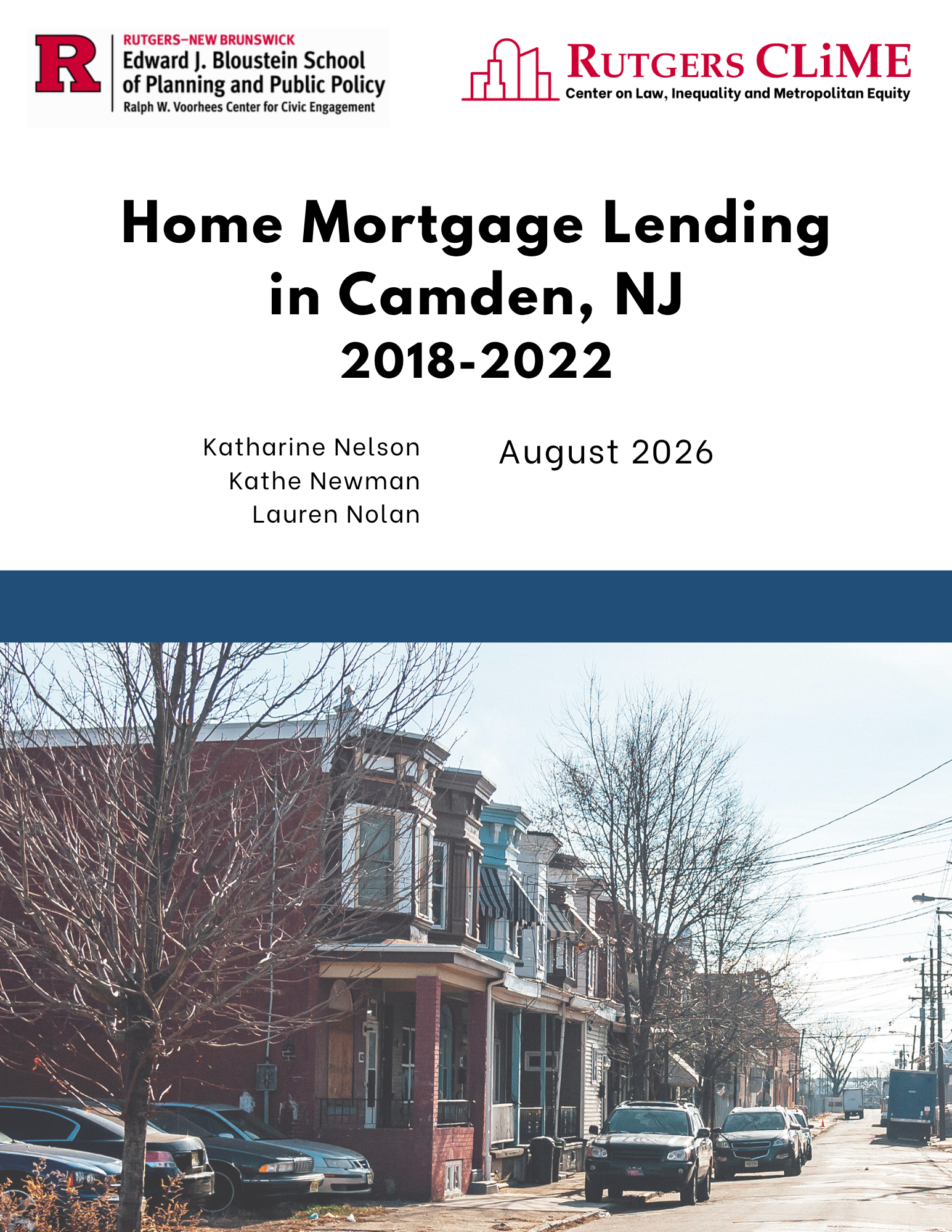
In partnership with the Rutgers Bloustein School's Voorhees Center for Civic Engagement and St. Joseph's Carpenter Society, a community development corporation in Camden, New Jersey, we sought to better understand home purchase and improvement lending in Camden between 2018 and 2022, a decade after the 2008 financial and liquidity crisis and the 2009 Great Recession significantly restricted credit access. We looked at patterns of home purchase and improvement mortgage originations, applications, and denials in Camden and found higher mortgage denial rates than elsewhere in the region, more expensive mortgages from the companies that have lower denial rates, and a critical gap in access to home repair loans. Our findings point to the prominent importance of non-depository mortgage companies in the provision of housing credit, raising concerns both about lender regulation and the need for greater bank presence in Camden's mortgage markets.
CLiME’s Guidance for Lawmakers on Investors and New Jersey Homes responds to the flood of proposed legislation in New Jersey to respond to the growth of institutional investors in single-family homes. This report describes the pending bills in New Jersey and offers expert recommendations on how legislators should understand the combined policy effects of a range of efforts, including bans, opportunity to purchase restrictions, tax strategies, and responses to various harms to renters through tenant-protection laws.
We offer four top level recommendations for New Jersey lawmakers:
Create an executive agency tasked with developing the infrastructure necessary to regulate institutional investors in single-family homes in New Jersey.
Prioritize a first-look law that mandates a wait period before investors may bid on a home once it goes on the market.
Impose limits on property-related tax deductions such as mortgage interest and depreciation to disincentivize investor ownership of single-family homes.
Prioritize various tenant protection bills aimed at responding to specific harms renters face from growing dominance of corporate landlords, including rapid rent increases, increased eviction actions, and habitability concerns.
This Update documents the Trump Administration's continued efforts to rewrite the meaning of racial equality in the United States. The administration’s efforts have kept pace with their first ten months, collected for CLiME’s November 2025 report presented as a four-pronged strategy aimed at:
Redefining race discrimination through a theory of antidiscrimination doctrine developed by the overwhelmingly white conservative legal movement, which has resisted racial progress through the courts since the at least the 1970s;
Dismantling the federal institutions responsible for civil rights enforcement by eliminating people and offices committed to the work of restorative justice and racial equity and repopulating those spaces with a sparse few ideological loyalists who selectively enforce civil rights laws through this redefined, ahistorical understanding of antidiscrimination;
Enforcing this colorblind, reverse-race discrimination ideology by weaponizing the federal checkbook to coerce institutions into ideological compliance and to defund any program or research that may document ongoing, system racial inequalities or support Black, Latino and Indigenous communities in any way; and
White washing racial gerrymandering efforts through political gerrymandering, while the Court ends the Voting Rights Act as we know it by subverting claims of racial discrimination to achieve policy goals–the effects of which often involve civil rights retrenchment–all the while knowing that the Supreme Court is ideologically and doctrinally aligned.
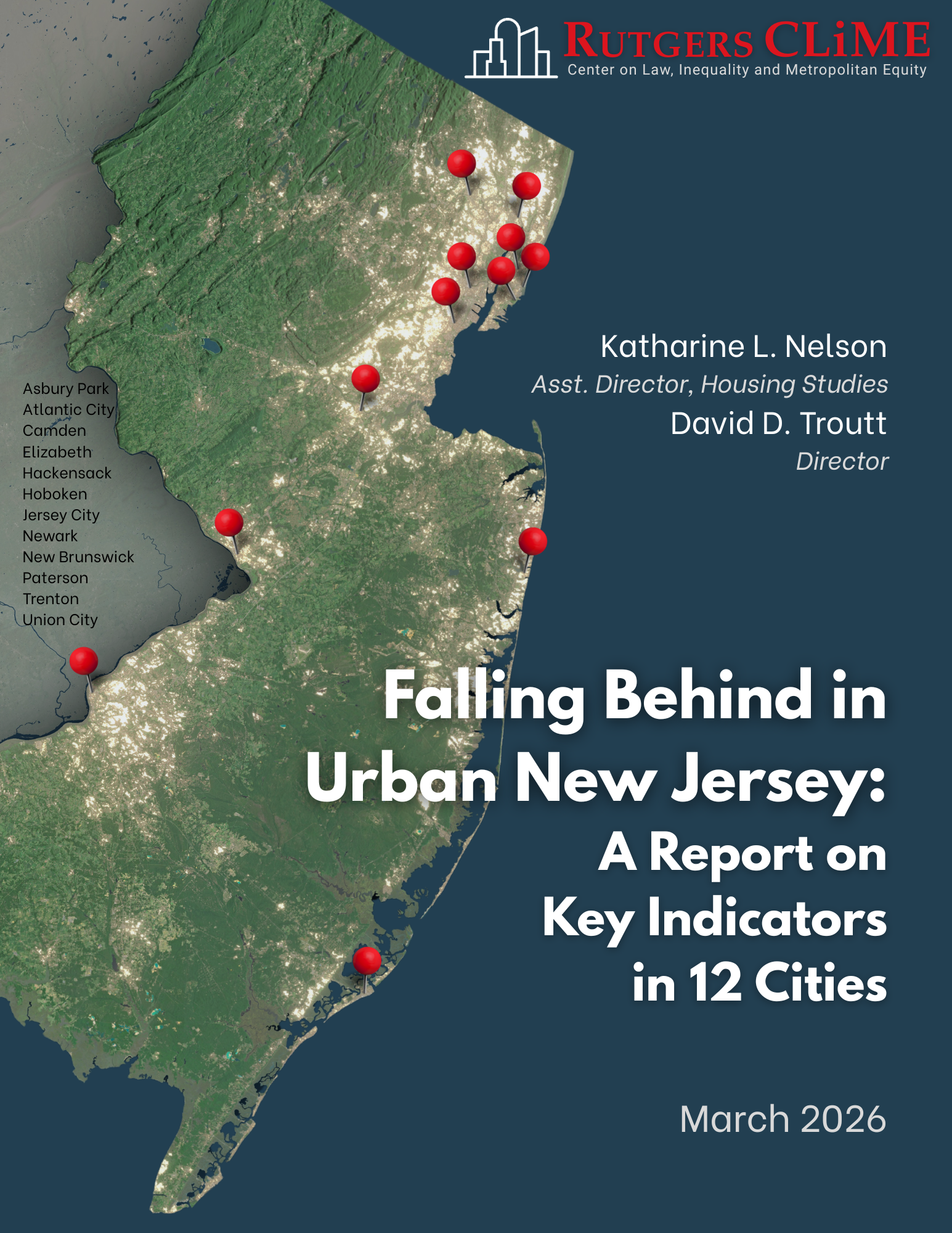
CLiME’s inaugural evaluation of 12 of New Jersey’s most populous cities reveals striking trends that reverse many of the last century’s assumptions about life in the Garden State. Despite dynamic changes in urban-suburban demographics, housing and job growth, one overriding fact prevails: economic inequality has hardened between cities and suburbs and within and across cities. We looked at social and economic trends in the state’s 12 most populous cities – Newark, Jersey City, Paterson, Hoboken, Union City, Hackensack, Asbury Park, New Brunswick, Trenton, Camden and Atlantic City – and found:
Urban population growth and residential development now outpaces the rest of the state.
The 12 cities are home to many working-class and immigrant residents, and more than half households struggle to make ends meet.
The 12 cities are home to the state’s poorest children, with poverty rates as high as 48 percent.
A lack of affordable housing is a problem statewide, but it’s especially pronounced in the gentrifying cities of the NY metro.
Read more to learn how these factors play out differently in different parts of the state and our recommendations for enhancing the economic prospects of New Jersey residents.
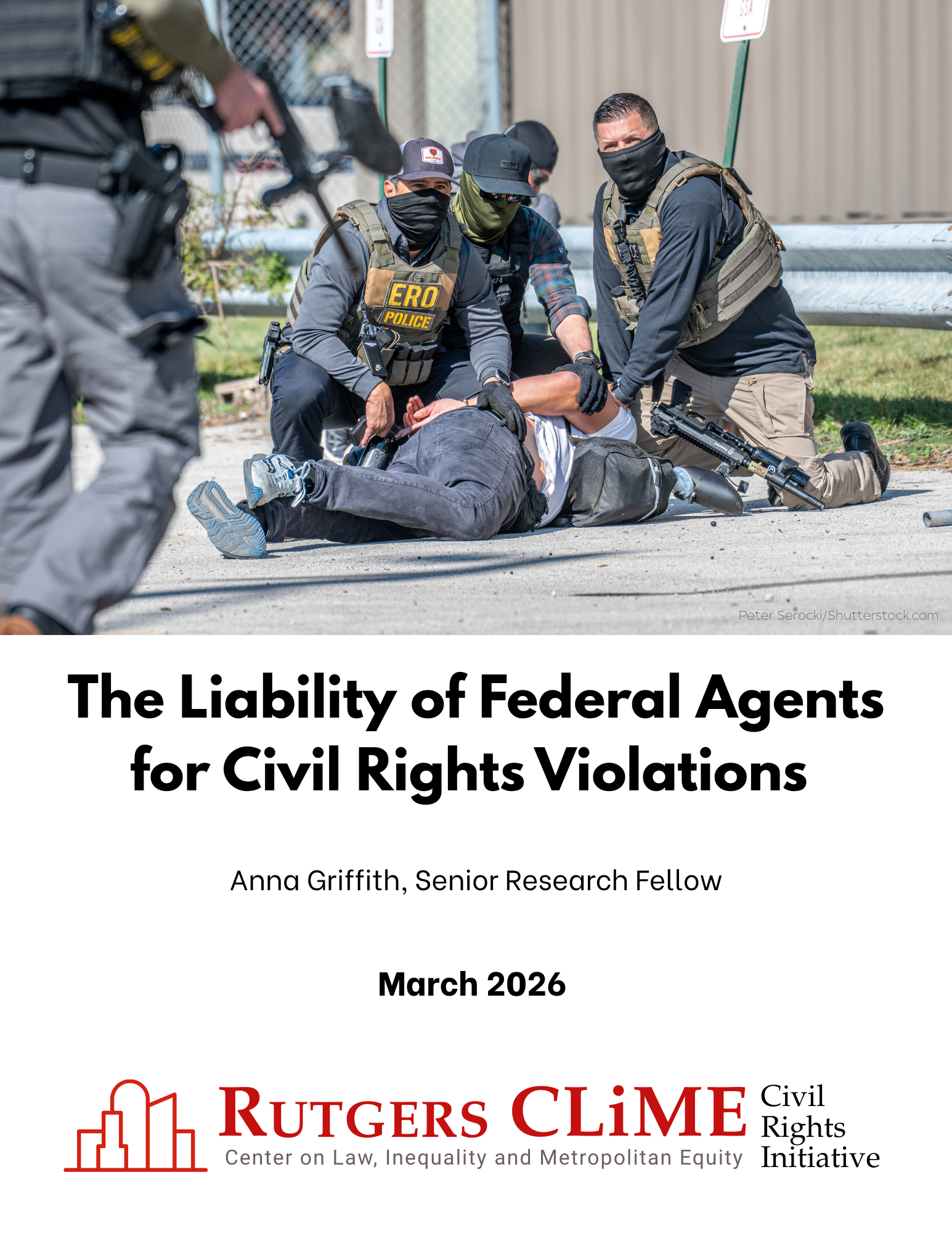
Can people sue federal agents for police brutality? In this memorandum, CLiME explores the very limited bases for finding ICE agents civilly liable for excessive force or deprivation of civil rights. The main issues involve:
restrictive federal legal standards and barriers to bringing a claim
unbridled and undue deference afforded to federal law enforcement agents on the job, and
underdeveloped state laws that have yet to provide legitimate alternatives to weak federal causes of action.
Courts appear to be generally hostile to government liability and the costs of accountability against federal agents. As a result, unlike police brutality by state and local law enforcement, legal remedies against ICE and other federal law enforcement are largely unavailable. Some scholars have proposed ways to close this legal gap, so far without success.

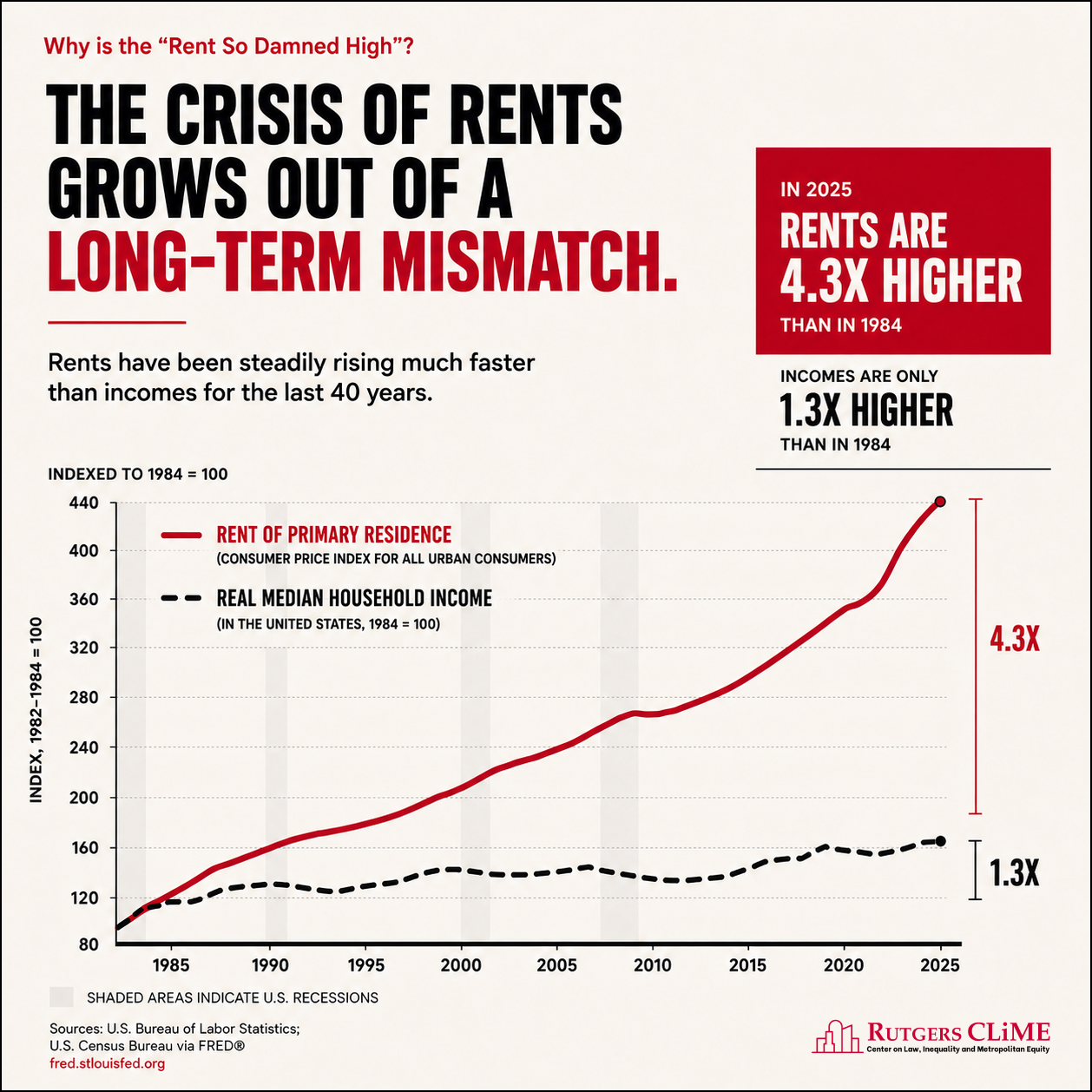
Why is The “Rent So Damned High”? explores the drivers of high and rising rents and proposes a series of policies to address rental unaffordability in New Jersey and respond to changes at the federal level. Most experts say the chief explanation for high rents is an undersupply of housing and push a “build, build, build” strategy to bring rents down. Our findings challenge the consensus. Through a deep dive of academic and public research, we identified four primary drivers of high and rising rents: inflation, undersupply, widening inequality, and the consolidation and professionalization of landlords and real estate.
Federal policy is embracing building as the foremost solution to the affordability crisis. Trump’s Big Bill permanently expanded the country’s largest affordable housing production subsidy program, the Low-Income Housing Tax Credit (LIHTC). Meanwhile, deeper subsidy programs that can reach low-income renters are threatened with large cuts. To make housing affordable, we must also address stagnant incomes and the consolidation of homebuilders and landlords.
Diverging Dynamics: The 2023 Displacement Risk Indicators Matrix (D.R.I.M.) Update for Newark explores how the risk of displacement in Newark has changed since 2010. Newark is experiencing the steady erosion of affordability as rents rise faster than incomes. In this latest installment of CLiME’s displacement analysis, diverging patterns of urban change are becoming clearer across wards with uneven but unmistakable signs of gentrification.
The East and Central Wards saw the most dramatic increases in new construction activity, the most rapidly rising rents, and the most pronounced increases in residents who are college-educated and/or affluent renters. The West Ward also shows signs of elevated renter vulnerability, with large increases in medium household incomes alongside rising rent burdens. The North Ward has very different housing market dynamics, with large increases in homeownership and much less residential construction. The South Ward shows the greatest signs of tenant vulnerability but also has the most affordable rental stock, compared to other parts of the city.

The Supreme Court’s decision in Students for Fair Admissions v. Harvard reshaped the constitutional landscape of higher education while leaving important questions of educational mission unanswered. By undermining diversity as a compelling interest under strict scrutiny judicial review, the Court dismantled the decades-long framework under which universities adopted admissions practices in pursuit of self-defined institutional goals. That model may fit elite private institutions like Harvard or UNC, but it fails to capture the full spectrum of American higher education.
This brief proposes that land-grant universities possess a distinct institutional interest in cultivating a diverse student body. This interest is grounded in their statutory mission, the historical purpose of the Morrill Acts, and the judicial deference traditionally afforded to congressional mandates that create and continue to govern land-grant institutions.
SFFA’s reasoning may be too rigid to accommodate the genuine diversity of institutional missions in American higher education. Recognizing this doctrinal blind spot is only the beginning of a broader scholarly conversation.

Metropolitan areas in New Jersey need to dramatically lower their building emissions to combat climate change and protect local health. However, metropolitan New Jersey faces several major challenges. First, federal and state law preempt New Jersey municipalities from adopting some stricter laws that could lower building emissions. Second, competition between municipalities creates a collective action problem that disincentivizes legal reform. Third, building emission reduction strategies can create unintended harm such as worsened indoor air quality and gentrification. To avoid these challenges, individual New Jersey municipalities can utilize metropolitan equity strategies to cooperate efficiently. However, the most impactful way New Jersey can decarbonize buildings may be for the state legislature to amend its building emissions benchmarking law to enable the state government to decarbonize buildings more effectively.

This report explores investor activity in Philadelphia, where corporate buyers are most active in parts of the city which are predominantly home to Black and Hispanic residents in West, North and Northeast Philadelphia. For this report, CLiME teamed up with the Reinvestment Fund and Housing Initiative at Penn, who are based in Philadelphia.
We identify the largest investors who are buying up the most single family homes, and who operate primarily as large-scale corporate landlords. The companies doing the purchasing changed during the pandemic, shifting from more local investors to those entering the market already active in other places.
We analyzed purchases of residential buildings before and during the pandemic, looking at sheriff sales, rental licensing, renovation permits, evictions, and code violations to determine the impact of these purchases on Philadelphia housing markets. We found that:
Larger corporate landlords were much more likely to evict tenants than smaller investors.
Larger investors more often took out permits to alter or improve their properties than smaller investors.
Investors large and small were much more likely to amass code violations than individual homebuyers
The largest corporate investors obtained rental licenses on 67% of the properties they acquired, compared to just 43% among smaller investors
The character of the highest-volume investors changed with the pandemic. From 2017 through 2019, eight of the top ten largest investors by volume were locally based. From 2020 through 2022, the four highest volume investors were either new to Philadelphia or had scaled up dramatically from the earlier period.
Philadelphia is a city with a proud legacy of affordable homeownership opportunities and an expanding set of tenant protections. In recent years, concerns about the impact of corporate investors purchasing single family homes in the city have grown, even as there is an evident need for capital investment in its aging housing stock. This report aims to inform policy interventions to promote stable neighborhoods, affordability, and high-quality housing options for all Philadelphians.
A few years ago, CLiME published Who Owns Newark? which showed that corporations were buying half of all 1-4 unit homes in the city. We continue to investigate and explore these issues throughout the region.

New Jersey homeowners are sinking in monthly bills. In this brief, we explore the sky-high and rapidly rising costs of being a homeowner in New Jersey. This includes both mortgage and non-mortgage housing costs. New Jersey has the property taxes, and among the most expensive housing prices in the country. In addition, New Jersey homeowners pay 20 percent more in utility costs than the national average, and are now facing soaring electricity bills related to supply challenges and the new demands of AI data centers. New Jersey’s homeowners’ insurance premiums are also going up much faster than other states, related to private companies’ responses to more extreme weather and construction and labor costs. As these various costs add up, more homeowners – especially those with lower incomes – are sinking into debt and many are deferring home repairs and maintenance.

In New Jersey, new construction is exempt from price controls for 30 years, even in municipalities with rent control ordinances. Given the other exemptions available to developers, it is questionable whether this exemption is necessary to spur new construction. This memo examines that question by laying out the history of rent control in New Jersey as well as the history of the new construction exemption, looking at case law involving the exemption as well as arguments for the exemption and critique of those arguments, and proposes alternatives to the exemption as either an abolishment or revision of the exemption. The history shows how the moderate nature of rent control in New Jersey suggests that its effect on new construction is overblown, the legislative intent was more about removing barriers to new construction without considering any balance with the prevention of rent gouging, rent control is relevant towards new construction, and significant revision, if not abolishment, of the exemption would have a beneficial effect for existing affordable housing.

The Other Cities: Migration and Gentrification in Jersey City, Newark and Paterson describes housing trends and neighborhood transitions in three mid-sized North Jersey cities that elude conventional descriptions of gentrification. All three have experienced population growth, increased immigration, loss of Black residents and a persistent lack of housing affordability. We describe their particular dynamics three ways: "Bedroom City", "Jobless Gentrification" and "Migrant Metro." Jersey City is the “Bedroom City” where population growth and higher prices are associated with its proximity to jobs across the Hudson River in New York City. Newark is in the midst of “Jobless Gentrification” where investment in expensive market-rate new housing and investor-led renovations raise prices without the corresponding job growth seen in traditional gentrification. Paterson is the “Migrant Metro”, a species of municipalities that have become mosaics of working-class immigration whose density alone—not jobs or new housing—has intensified a lack of affordability. These characteristics distinguish them from traditionally gentrifying cities, but their traits are important bellwethers of urban life across the U.S.

This report analyzes the compliance challenges public universities face since the issuance of several executive orders that threaten investigation and defunding for a broad range of activities associated with “DEI” and other undefined terms. In Part I, we examine the language of the federal directives in light of universities’ historic obligations and current circumstances. Many institutions have so far chosen some version of either pre-emptive obedience, wait-and-see inaction or offensive defiance. We suggest that institutions will face some combination of four possible courses of action: continue to obey civil rights law, anticipate new standards, manage risks and defend current practices.
Schools’ circumstances are not uniform. Yet all must conform to current legal standards, which are often inconsistent with the new federal policy directives. To clarify, this report sets out the existing state of the law since Students for Fair Admissions, including the scope and limitations of that Supreme Court decision, the continued allowance of race-neutral means to achieve racially diverse learning environments and the applicable tests used by the Court under Title VI. Since many organizations and institutions have already challenged the federal administration in court, we conclude with an analysis of the legal defenses—mostly on First Amendment grounds—that have so far succeeded in securing injunctions against certain banned practices. Part II of this report sets out best practices universities across the United States have used to stay in compliance with civil rights law yet still maintain environments that are diverse, inclusive and consistent with equitable principles.

Discussions about Vice President Kamala’ Harris’ record as a progressive prosecutor have offered an opportunity to consider what the next president could do to help spur equitable criminal justice reform. While recognizing that policing is largely a local endeavor, it is important to identify how the next president can leverage existing federal programs to contribute to larger criminal justice reform and equity efforts. In this paper we propose that the next administration restructure the Justice Assistance Grants (JAG) and Community-Oriented Policing Services (COPS) grants in order to support community-based criminal justice programs (CCJP) to achieve equitable criminal justice reform. These programs, which emphasize partnerships between law enforcement, prosecutors, and non-law enforcement organizations, aim to reduce crime and recidivism through rehabilitation, mental health services, and social support. The proposal we offer draws inspiration from Vice President Kamala Harris’s "Back on Track" program, which successfully helped first-time nonviolent offenders avoid incarceration through alternative sentencing that focuses on rehabilitation. The paper argues that similar programs, if federally supported, could help contribute to equitable criminal justice reform by fostering trust between law enforcement and communities, reducing police brutality while also preventing crime and recidivism.

On January 12, 2024, Governor Phil Murphy signed the Wealth Preservation Program law, an ambitious reorganization of the foreclosure process in favor of second chances, non-profit rights of second refusal and affordable home ownership. Then-Assemblywoman, now-Senator Britnee Timberlake, introduced this law because New Jersey has the highest foreclosure rate in the country, with one foreclosure for every 2,271 homes.[1] The potential impact of this law goes beyond just reducing the number of foreclosures. It potentially limits institutional investors’ opportunities to purchase foreclosed homes at sheriff’s sales by providing ordinary homebuyers initial opportunities to bid on properties on more favorable terms. Under the Act, defaulting homeowners, their next of kin or tenants have the first chance to re-purchase their homes from sheriff sales at a publicly disclosed discount price by paying only a 3.5% down payment with 90 days to close. If they do not elect to purchase, non-profit community development corporations (CDCs) have the next right of refusal in exchange for deed restrictions that keep the property affordable to subsequent owners or renters.

This is a report about how cities can better organize and manage their data about the property they own in order to promote transparency and advance critical policymaking. Newark, like many legacy cities, owns hundreds of parcels through tax foreclosure and abandonment that can be put to more productive use and even generate needed revenue. Because of different inputs from different departments, its property data system contained duplication and gaps that prevented policymakers and stakeholders from getting a clear picture of these public assets. In partnership with city staff, CLiME helped to resolve the data organization problem and set property management on a new, more accurate and user-friendly course. Along the way, we learned details about the nature and amount of city-owned properties, how they’re zoned and where they’re located. We concluded that much more of this significant inventory can and should be put to work advancing long-held goals of equitable development. We built three demonstrations to simulate this usage that cover three major areas of policy: affordable housing production, commercial and industrial development and green space/environmental risk mitigation. Each of these is an area in which the Baraka administration is already active in setting aggressive policies. Some of those policies already make use of the asset of city-owned land. Until recently, it was impossible to see the scope of particular uses because the data did not readily permit it. Now the data is cleaner and clearer.
Individual break-out reports from the full report are also available:

This memorandum provides useful information regarding the management of a loved one’s affairs (estate) when they have passed. Estate matters can be laborious and emotionally charged. This memorandum will explain probate and administration in New Jersey and provides information for you to begin navigating the process of managing your loved one’s estate. However, this memorandum provides general information, and is not intended to serve as legal advice. No two estates are the same and the law on the administration of estates is extensive. It is recommended that you consult with an experienced estate attorney to answer any questions related to your particular circumstances.

The following resources are designed to help understand and navigate estate administration in New Jersey when a loved one passes with a will. A flyer is also available for when a loved one passes without a will here.

This report shows that the national trend in investor buying of 1-4 unit homes in predominantly Black neighborhoods is most acute in Newark, New Jersey where almost half of all real estate sales were made by institutional buyers. The trend grew out of the foreclosure crisis that wiped out significant middle-class wealth in particular Newark neighborhoods. Those neighborhoods became the targets of investors seeking passive returns from rents. Those largely anonymous outside companies now set neighborhood housing markets on terms that primarily benefit their investors.
While CLiME detected no illegal activity, the threats to Newarkers and government policy goals are significant. They include rapidly rising rents, decreased homeownership, higher barriers to affordable housing production goals, renter displacement and less stable communities. Sadly, this reality continues a long pattern of economic threats to predominantly Black and increasingly Latino neighborhoods in a state whose communities are among the most segregated in the country. From racial exclusion to predatory lending, from foreclosure to the extraction of rents, Newark’s experience demonstrates what can happen when local economies ignore equity.
CLiME’s analysis documents a dramatic increase in institutional investor activity in Newark’s residential market starting around 2013. As of 2020, almost half of all Newark’s residential sales were to institutional buyers.
This report and accompanying matrix are a critical evaluation of New Jersey’s tax incentives programs through the policy lens of equitable growth. Persistent inequality between New Jersey’s communities and households hurts all of New Jersey. We assumed that the expenditure of taxpayer dollars for private economic gain should further a public interest in making weaker markets stronger—i.e., equitable growth. We identified every state tax incentive that contained some aspect of economic fairness and analyzed each for how well it contributed to producing equitable growth. As the matrix at the end of the report shows, we found few gains and many lost opportunities.
If economic development broadly represents New Jersey’s interests in promoting economic welfare, then equitable economic development refocuses state policy on the state’s interest in improving economic welfare in the places where market need is greatest. Since many of these needs converge in communities of the state that have struggled with disinvestment and undernourished markets for many years, we believe a critical public purpose is served when the state steps in to revitalize markets where no one else will. This represents a policy of equitable economic development, an expansion of growth and opportunity.

CLiME conducted an affordability and gap analysis of Newark's housing stock and found a severe gap in low-rent units. We estimate that the City needs an additional 16,234 units renting for about $750 per month to meet residents' existing needs.
CLiME’s approach to assessing affordability is rooted in the local context. We calculate a Newark Median Affordable Rent (NMAR) of $763 per month. This is $330 less than Newark’s median market rent, and more than $600 less than Fair Market Rent (FMR), created by the Department of Housing and Urban Development. We also develop a methodological innovation to integrate the City’s rental housing subsidies into the affordability analysis. This procedure, the first of its kind as far as we know, provides a much closer picture of affordability in a City where at least 28% of all units are subsidized.

In this first installment of a faculty essay series, CLiME asked Rutgers professors affiliated with the center to provide brief analysis on some of the many institutional crises exacerbated by the Coronavirus pandemic and to offer solutions. Law Professor Rachel Godsil discuses the loss of public revenues to struggling communities and offers a pipeline to millions. Political Scientist Domingo Morel reveals the growing crisis in public pension fund commitments and a possible path to meeting those obligations. Law Professor Laura Cohen takes readers inside juvenile justice to show the increased risk of viral infection incarcerated youth face as well as the steps advocates are taking on their behalf. Director David Troutt looks into the future to interrogate claims that “we are all in this together” and offers an alternative set of policy priorities we would pursue if mutuality really mattered.

The Rutgers Center on Law, Inequality and Metropolitan Equity joins the national push for transformative change to dismantle systemic racism, a call that follows the coronavirus pandemic and recession and the police killings of several African Americans, including George Floyd. But what does systemic racism mean?

The coronavirus pandemic resembles nothing in any of our lifetimes, and its impact will be felt long after it ends. As an economic story, it will mean immediate loss and uncertainty for many households, probably recession, possibly depression. People who can’t afford to hoard or have jobs that can’t be done remotely will be exposed more often, putting everyone in their households at greater risk and subject to an overburdened health care system. These effects will heighten the social determinants of health for populations that already struggle with underlying conditions statistically more than others. And, with predictable cruelty, it will target black, Latino and lower-income families for disparate death and loss. Recent reports from counties that keep data on race show that it has.

As a member of a local affordable housing coalition and partner to Mayor Baraka's effort to implement the second right-to-counsel (RTC) ordinance in the country, CLiME led the research design of such a system and the supporting basis for its legality under New Jersey law.
This memorandum was submitted to the City of Newark in early February, with recommendations for implementing a system of free legal services for indigent Newarkers (incomes below 200 percent of the median) facing imminent eviction proceedings in Essex County court.

Making Newark Work for Newarkers is the full report of the Rutgers University-Newark Project on Equitable Growth in the City of Newark, written by CLiME and incorporating research conducted in conjunction with a university working group whose work began last April. We viewed the goal of equitable growth first in the context of housing issues before expanding to think about the fabric of community life and economic opportunity in the city.

As Newark experiences unprecedented growth potential, Newarkers express more and more anxiety about the prospects of housing displacement brought on by the processes of gentrification that have transformed urban neighborhoods across the United States. Given the recent history of other cities in its metropolitan neighborhood—New York, Hoboken and Jersey City—Newark would seem poised to attract the kind of global capital that has accelerated so much economic development among …

The City of Newark is undergoing rapid transition, with creative political leadership and development cranes dotting its sky. In February 2016, CLiME launched a comprehensive study of housing trends in the City. In May 2016, CLiME led a Rutgers University-Newark anchor initiative that researching laws and policies that might promote more equitable growth in the City as it changes. This Housing Research Brief represents the first installment of our almost year-long work. It provides quantitative snapshots …